

A tiny mirror catches the light. But behind that glint lies a craft shaped by generations of skill, intricate stitches and the hands that keep the tradition alive. At Rangsutra, these craft traditions are not simply preserved—they are given space to find new expression while creating meaningful opportunities for the artisans who carry them forward.
The Kaanch collection draws from the desert craft tradition of mirror work, bringing together tiny mirrors, colourful Pakka hand embroidery, comfortable cotton and jewel-toned colours. Named after the Hindi word for mirror, Kaanch explores what happens when a craft deeply rooted in tradition meets a new canvas—without losing the character that makes it special.
The Craft Remains, the Canvas Changes
What happens when a craft rooted in the desert finds a new canvas?
Traditional craft can find new relevance when it is allowed to enter new forms of expression. The Kaanch collection brings this idea to life through various palettes, where tiny mirrors and Pakka hand embroidery create different expressions of the desert craft tradition.
The collection gives the craft a new context while keeping its character intact. It shows how heritage craft can continue to evolve, reaching women through clothing that feels connected to Indian textiles while fitting naturally into modern ethnic dressing.
Kaanch: Where Colour Meets Craft
If mirrors are what give Kaanch its name, colour is what gives the collection its personality. The same desert craft takes on a different mood as it moves from blue to brown to pink, showing how much expression can come from the way a craft is placed, layered and paired.
The Kaanch Blue Front-Yoke Cotton Kurta With Pacca Hand Embroidery makes the front yoke the starting point of that story. Multicoloured Pakka embroidery and tiny mirrors draw the eye towards the centre, while the gathered waist and flared sleeves let the details unfold across the silhouette. The jewel-toned blue gives the intricate work a striking backdrop, making the piece feel vibrant without letting the craft get lost.

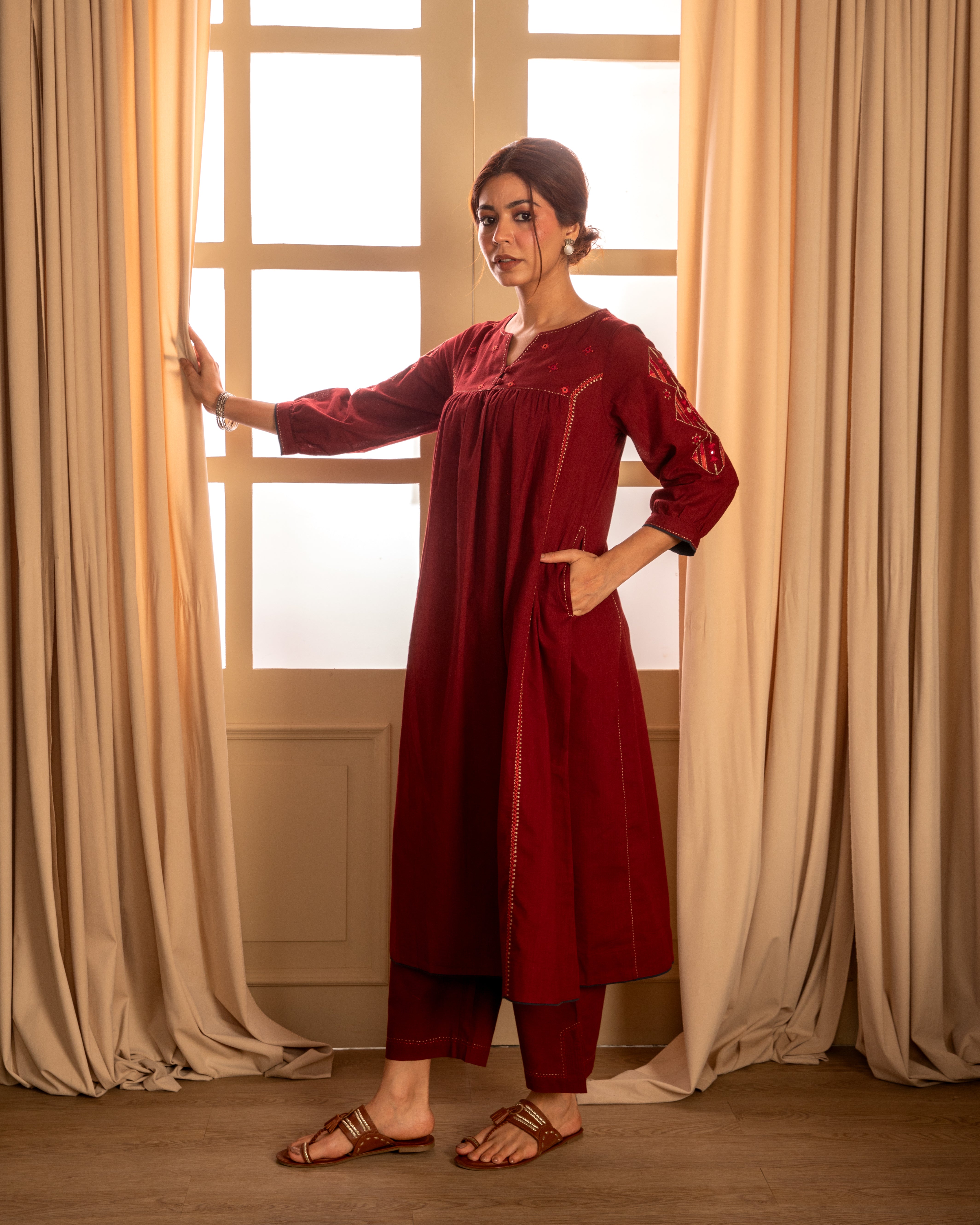
Then comes the Kaanch Brown Round-Neck Cotton Kurta With Pacca Hand Embroidery, where the mood becomes deeper and more earthy. Here, mirror work travels across the front and side panels, meeting desert embroidery stitches, contrast bands and gathers along the way. Against the jewel-toned brown, the colours of the embroidery stand out almost like small fragments of the desert brought together on fabric.
The Kaanch Pink Front-Yoke Cotton Kurta With Pacca Hand Embroidery takes the same craft story in a brighter direction. Its pink canvas lets the multicoloured embroidery and mirrors feel playful, while the front yoke and gathered waist give the detailing a natural focal point.

Together, the three pieces reveal something important about Indian craft: its identity does not have to depend on one fixed colour, form or setting. Give it a different canvas, and familiar techniques can tell a completely new story.
Keeping Craft Alive Through Livelihoods
For Rangsutra, keeping a craft alive also means creating conditions in which the people practising it can build sustainable livelihoods. Artisans are not simply producing garments; they are part of an artisan-led enterprise where skill, work, income and participation come together.
This matters because craft preservation cannot depend only on keeping a technique unchanged. The people practising that technique need meaningful work and opportunities that allow them to build more secure futures. An income from craft can contribute towards children's education, household needs and greater economic independence.
That makes artisan made clothing part of a larger story. The garment carries the skill of the person who made it, while the work behind it can help create possibilities beyond the garment itself.
What Ethical Production Looks Like
The story also extends to where and how the garments are made. Rangsutra works through organised production centres within artisan communities. These centres are well-led and ventilated, with access to water provided by Rangsutra, fire-safety arrangements and safe working conditions.
Fair wages and applicable ESI/PF support form part of the broader approach to artisan wellbeing. Production also considers its environmental impact through waste management and recycling, while dyeing wastewater is treated before disposal.
This approach reflects Rangsutra's wider commitment to responsible production and its work towards six Sustainable Development Goals.
A New Chapter for Indian Craft
Mirror work has never been only about decoration. It carries the memory of a place, the knowledge of artisans and the character of a craft tradition.
Kaanch allows that story to continue in a different setting. The mirror still catches the light. The embroidery still carries the skill of the artisan. But the garment becomes a new way for that craft to enter the lives of women today.
Because a craft does not stay alive by remaining frozen in time. It stays alive when the people, knowledge and skills behind it have the opportunity to move forward.
FAQs
1. What is mirror work in Indian fashion?
Mirror work is an Indian textile craft in which small mirrors are secured to fabric using decorative embroidery techniques.
2. What is the Kaanch collection?
Kaanch is a Rangsutra collection inspired by desert craft, combining mirror work and Pakka hand embroidery with cotton slub and jewel-toned colours.
3. Can mirror-work clothing be worn beyond festivals?
Yes. Kaanch uses wearable silhouettes and breathable cotton, allowing mirror work to become part of different styles of dressing.
4. What makes Kaanch different?
It brings traditional mirror work and Pakka embroidery onto a new canvas through colour, fabric and contemporary silhouettes while retaining the character of the craft.
5. How does Rangsutra support artisans?
Rangsutra connects artisan skills with organised production, fair wages, safe working conditions and opportunities for more sustainable livelihoods.


